Current page


Arcus
The US stock market is open for 32.5 of the 168 hours in a week. Every other hour, prices on the exchange stand still while the world keeps producing reasons for them to move. Earnings land after the close. News breaks on a Saturday. Asia trades a full session before New York wakes up.
On Arcus, those hours belong to you. Stock Tokens trade around the clock, so when something changes on a Sunday night, you can act on it rather than wait for Monday’s open.
Trading at 3am does work a little differently from trading at noon, and the traders who get the most from a 24/7 market are the ones who know why. It starts with a distinction most trading apps blur: what you are shown and what you trade are not the same number.
This post covers where your price comes from, what changes when the underlying market closes, and how to read the numbers in front of you at any hour.
(This is about Stock Token spot trading. Equity Perpetuals are priced differently and trade 24/7 regardless of the underlying’s hours. For those, see how Arcus handles Equity Perps outside regular trading hours.)
One Screen, Three Numbers
At the top left of the asset page sits the reference price. It tells you where the market for that Stock Token is. It updates continuously, has no size attached, and nobody is committing to trade at it. Think of it as context, not an offer.
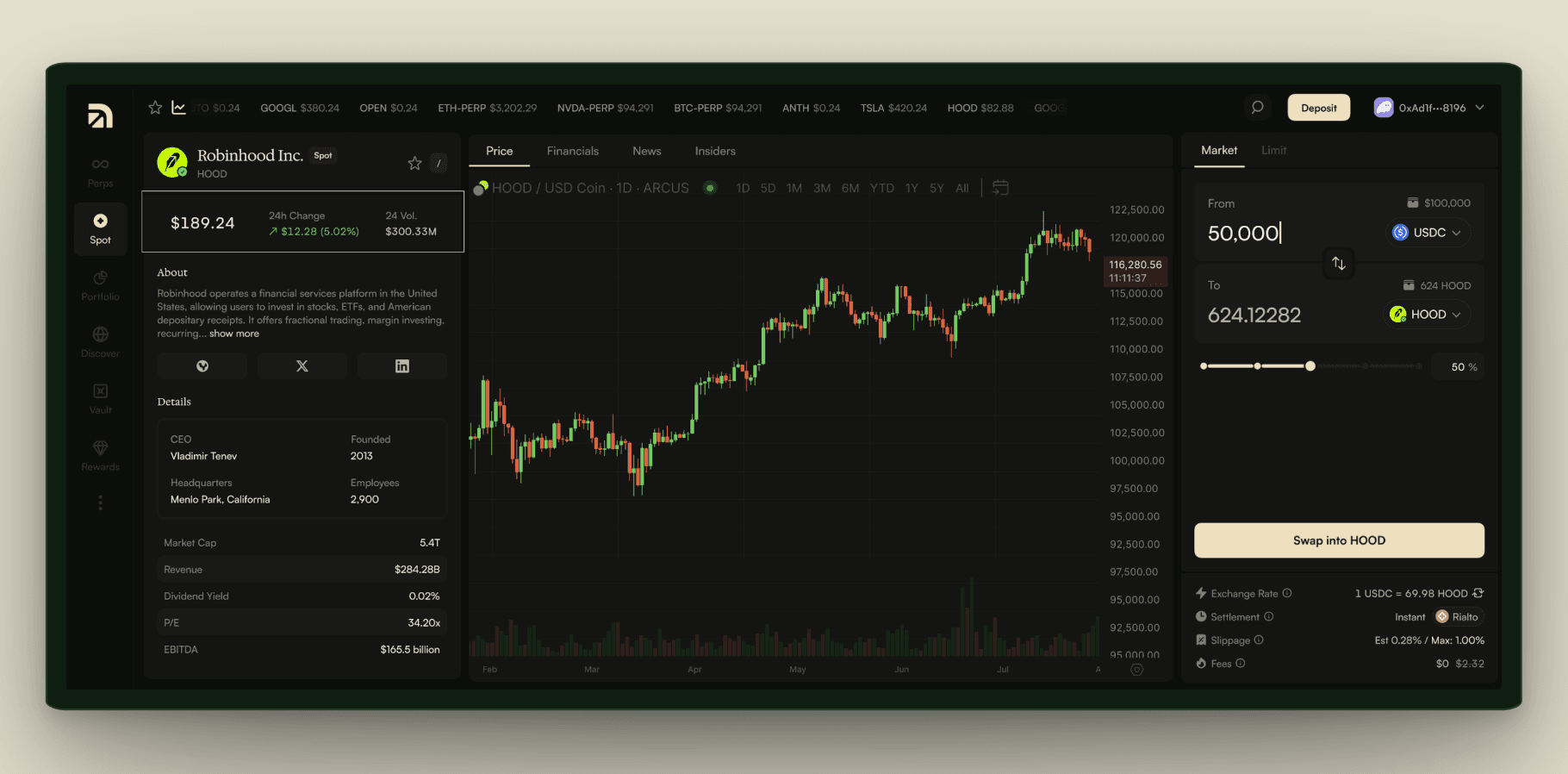
Enter an amount, and the swap panel shows your quote: an estimate for your exact size, built from live market maker pricing. This is the number to watch, because it reflects your trade specifically.
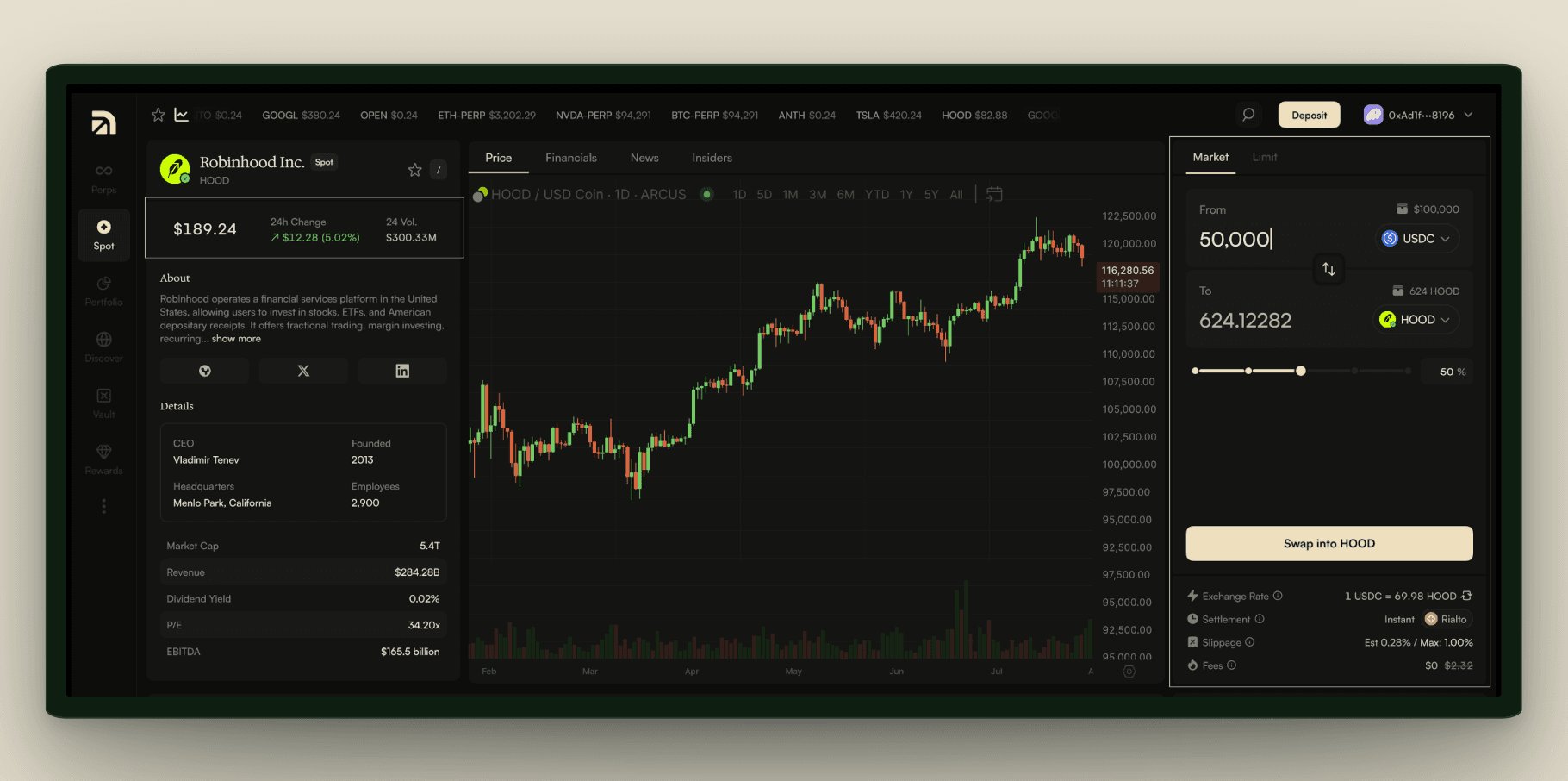
Confirming produces the third number, your fill. Confirming signs an intent with a floor, the worst price you will accept, set by your slippage tolerance. Your fill can settle slightly better or slightly worse than the quote, but it can never come back below your floor. Whatever the hour, that protection holds.
The rest of this post is about the quote and the fill behind it, because that is where the hour shows up.
Where Your Quote Comes From
Spot trading on Arcus runs primarily on request-for-quote, or RFQ. Instead of reading a price off an order book, you ask for one. Market makers compete to price your specific trade, the best quote wins, and the trade settles on-chain. The spot router can also draw on on-chain liquidity pools, though most fills come from makers competing for your trade.
There is no resting order book for spot. Perpetuals have one; spot does not. Your quote reflects what a maker will commit to at that moment, for the size you are looking to trade. That competition works in your favor: every maker responding to your trade knows only the best price wins.
Because the quote comes from a market maker, it reflects what that maker can do with the position once they take it on. What they can do changes with the hour.
Why the Trading Session Matters
While US markets are open, a maker pricing your trade can actively reference the deep, live stock market. They can hedge almost as soon as they take the position, so the risk they carry lasts seconds.
That is why daytime spreads are tight. The spread here isn’t a bid and an ask on a book - there is no book. It compensates a maker for holding a position they did not want, in order to fill one you did. When they can pass that position straight on, the compensation needed is small.
What Changes After the Close
Once the US market closes, that hedge is no longer available on demand. Whoever fills your Sunday trade holds it until the market reopens, and prices it without a live reference to check against.
Two things follow. Spreads widen, because the risk being covered has grown. And quoting becomes more selective, because some positions are harder to carry than others.
How much changes depends on the name. A heavily traded name like NVDA stays straightforward to price at any hour, so its spread stays workable. A thinner name is harder to hedge and harder to value without a live market, so its spread widens further.
Occasionally a maker will return no quote at all for a while rather than show a price they cannot stand behind. That is firm pricing working as intended: every quote you do see is one a maker is prepared to honor.
None of this arrives as a surprise. The cost of off-hours liquidity is already in the quote in front of you, before you commit to anything.
Which Names Quote, and When
Coverage follows the same pattern. The most liquid names quote continuously, weekends included. Others quote around the clock on weekdays but are not quoted over the weekend, with coverage expanding over time.
So whether a given Stock Token is quotable at any moment comes down to two things: which Stock Token, and which hour.
US Markets Open | US Markets Closed | |
|---|---|---|
How your quote is priced | RFQ: makers compete for each trade | RFQ: makers compete for each trade |
Behind the quote | Live reference of the stock on the stock exchange | No live reference |
What the spread covers | Seconds of hedging risk | Holding the position until the stock market opens |
Spreads | Tightest | Can be wider, varying by name |
Coverage | Names quote across the board | Most liquid names quote continuously; some names are not quoted at weekends |
A thin traded name | Quotes readily | May briefly return no quote |
What Never Changes
The mechanics are the same at every hour. Before you commit, the swap panel shows the all-in quote for your size alongside your slippage tolerance, the minimum you are willing to accept.
Quotes are live and last a few seconds, and if one expires before you confirm, a fresh quote is one tap away. Arcus currently charges no fee on spot trades and covers network fees, so the quote you see is the full picture.
And the floor always holds. Your fill can land a touch better or worse than the quote, never below the minimum you agreed to.
What changes off-hours is the price on offer, not the protection around it.
What This Means for Your Risk
What you are holding overnight depends on how the position is built. A Stock Token carries no leverage, no funding and no liquidation. A closed market cannot force your position shut, and there is no margin to manage over a weekend.
What does not change is market exposure. A Stock Token can rise or fall in value like any other position, and holding one through a quiet stretch does not change that.
So the off-hours difference is about execution, not exposure. It shows up as a wider spread, more price impact on a large order, or a thin name that briefly goes unquoted. Trading during off-hours is a choice with a knowable cost, and your quote shows you that cost before you commit.
The market never closes. Now you know how it stays open.
—-
Arcus is a blockchain-based smart contract protocol that permits self-custodial peer-to-peer trading of Stock Tokens, cryptoassets and perpetual futures. Arcus is not a regulated financial services provider, and it is not available in the U.S., Canada, United Kingdom and other restricted jurisdictions.
Stock Tokens are tokenised securities that provide economic exposure to a relevant underlying equity instrument or ETP through a contractual claim against the Issuer for a cash Redemption. Stock Tokens involve risks not present, or not present to the same extent, in traditional stock ownership, including private-key loss or compromise, limited redemption access, liquidity constraints, price or tracking divergences from the underlying, and uncertain or evolving regulatory treatment.
Trading Stock Tokens, crypto assets or perpetual futures is risky and involves risks of loss, particularly when using leverage. Do your own research.
This content is provided as a general tool for users to learn about or interact with Arcus on their initiative, with no endorsement or recommendation of any trading activities. Users or potential users of this content should not regard it as involving any form of recommendation, invitation or inducement to deal in Stock Tokens, cryptoassets or perpetual futures. Nothing herein should be used as legal, financial, tax, or any other form of advice.
In no event will Pocket Protector Labs Inc. or its affiliates be liable for any loss or damage arising from or in connection with the use of Arcus or this content. By continuing to access this content, you agree to the Interface Terms of Use, Protocol Terms and Privacy Policy.
Market analysis is facilitated with charts by independent third party service provider(s).
What is Arcus?
Arcus is a decentralized exchange built in partnership with Robinhood on Robinhood Chain. Users from eligible jurisdictions get one self-custodied account to trade Stock Tokens (spot, zero fees, 24/7), and cross-margined perpetual futures across equities, crypto, commodities, and indices - 24/7, with up to 50x leverage.
When is Arcus Launching?
Arcus is live in Beta. Spot Beta is open now to all eligible users, no waitlist needed. Perps Beta opens July 1, 2026, starting with waitlisted users and rolling out by cohort, ahead of a full launch later in the year. Join the waitlist and we'll let you know when your cohort opens. Arcus isn't available in the United States, United Kingdom, Canada, or other restricted jurisdictions, as set out in the Terms of Use.
What's the connection to dYdX?
Arcus is the next chapter for the team that built dYdX. dYdX Chain continues to operate. Arcus introduces new asset classes - equities, indices, commodities - alongside crypto perps, on a chain purpose-built for the throughput these markets require.
How does the waitlist work?
Only perps are waitlisted; Spot Beta is open to all eligible users. To join the waitlist, visit waitlist.arcus.xyz, and connect your wallet and X account. Your position comes down to two things: your prior on-chain trading history (perps volume across venues like dYdX, Hyperliquid, and Lighter, with real-world-asset (RWA) volume as a bonus), and referrals of other validated traders. You can connect multiple wallets to aggregate your history and move up faster. The earlier you join, the earlier you trade.
Where can I learn more?
Read the Arcus blog, follow @arcus_xyz on X, and join our Telegram for live updates.