Current page


Arcus
Every perps trader has lived some version of this night: five positions on, four of them fine, and one of them bleeding. You are not worried about the trade that is losing. You are worried about what it is doing to everything else, because on cross margin, your positions share a fate. One pool of collateral stands behind all of them at once, and a bad night in one market can pull margin out from under every other trade you have running.
Cross margin is capital efficient, and it is the go to default for many traders, most of the time. But that shared fate is the price of it, and every trader eventually meets the night where they would have paid anything to make one position stop mattering to the rest.
Isolated positions are that alternative. Each position gets its own margin, its own liquidation price, and its own walls. What happens inside stays inside.
What an Isolated Position Is
An isolated position is a perps position with a dedicated slice of collateral assigned to it alone. That margin is the position’s entire claim on your account. If the market moves against it, losses draw only on the margin it was given. If it is liquidated, the losses stop there. Every other position and the rest of your collateral stay untouched.
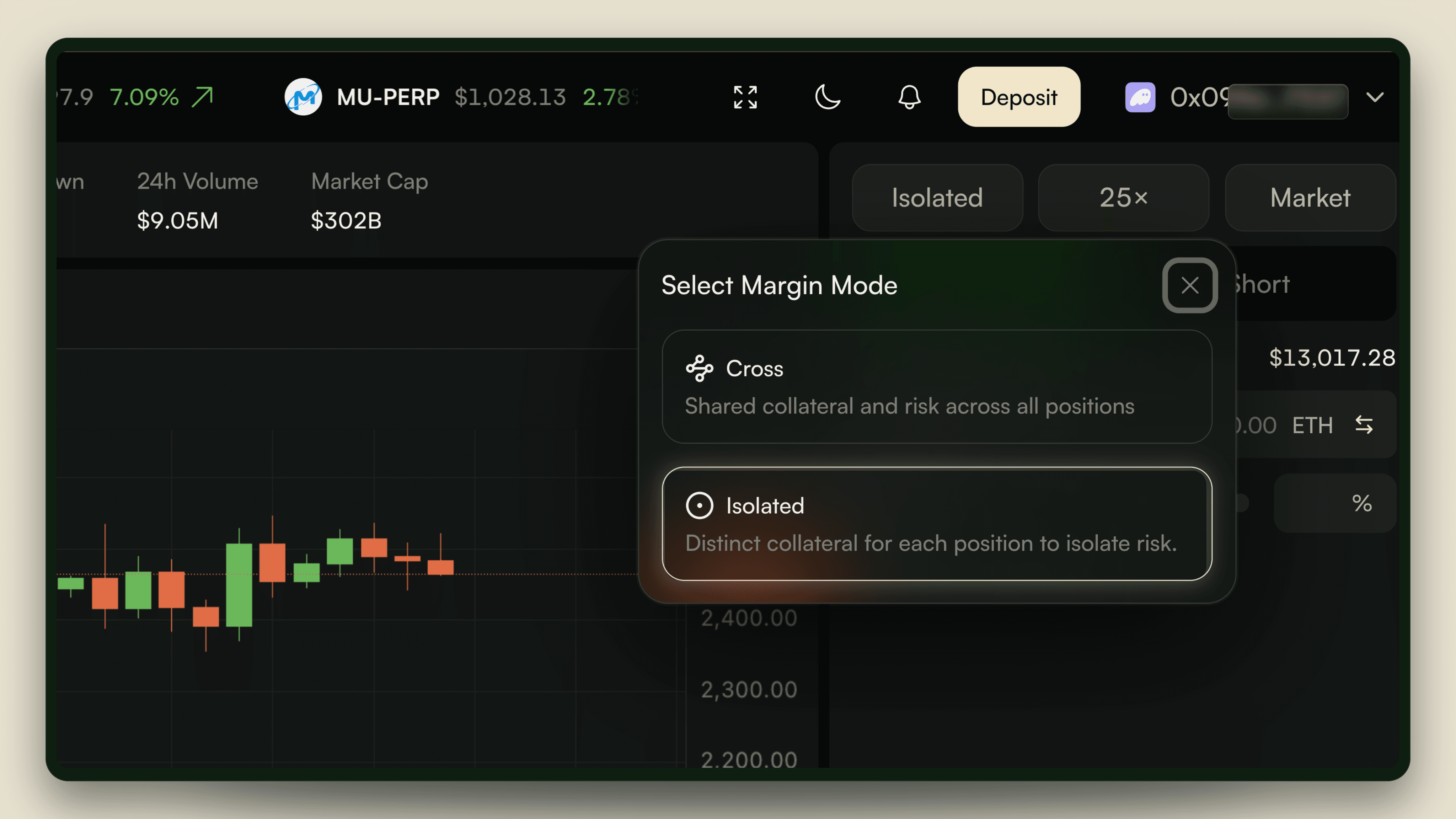
In practice: the margin you assign is the most that trade can take. Unless you decide to give it more. You can add margin to an isolated position, or pull spare margin out of one that is working, but nothing moves unless you move it. The worst case stops being a question you answer at 3am and becomes a number you chose, and can change only on purpose.
Cross margin is not going anywhere. The two modes sit side by side, chosen position by position, and many traders run both: cross for the correlated core, isolated for everything that deserves its own budget.
A Live Example
Say you have $10,000 in collateral and four positions running. You want a fifth: a BTC long you believe in, but not one you want to defend at 3am.
You open it isolated and assign $500 at 10x - a $5,000 position. Your liquidation price appears the moment you open it, about 8.5% below your entry, calculated against that $500 alone.
BTC drops 10% overnight. The position liquidates and you are out the $500 you assigned it.
Your other four positions never moved. Their liquidation prices never shifted. The remaining $9,500 was never in play.
The same trade on cross margin: that drawdown draws against the full $10,000, and every other position’s liquidation price moves as it bleeds.
One Account, Two Modes
Nothing about the account changes. Same self custodial property, same markets. Isolation is a choice made per position at open, and the mechanics do not change with it. Funding, fees and liquidation work the same way inside an isolated position as they do in cross. The difference is how far a loss can go.
That is the entire feature. No new account to fund, no new interface to learn. One more decision at open, and it is the decision that defines the trade: “how much is this idea allowed to cost?”
—-
Arcus is a blockchain-based smart contract protocol that permits self-custodial peer-to-peer trading of Stock Tokens, cryptoassets and perpetual futures. Arcus is not a regulated financial services provider, and it is not available in the U.S., Canada, United Kingdom and other restricted jurisdictions.
Stock Tokens are tokenised securities that provide economic exposure to a relevant underlying equity instrument or ETP through a contractual claim against the Issuer for a cash Redemption. Stock Tokens involve risks not present, or not present to the same extent, in traditional stock ownership, including private-key loss or compromise, limited redemption access, liquidity constraints, price or tracking divergences from the underlying, and uncertain or evolving regulatory treatment.
Trading Stock Tokens, crypto assets or perpetual futures is risky and involves risks of loss, particularly when using leverage. Do your own research.
This content is provided as a general tool for users to learn about or interact with Arcus on their initiative, with no endorsement or recommendation of any trading activities. Users or potential users of this content should not regard it as involving any form of recommendation, invitation or inducement to deal in Stock Tokens, cryptoassets or perpetual futures. Nothing herein should be used as legal, financial, tax, or any other form of advice.
In no event will Pocket Protector Labs Inc. or its affiliates be liable for any loss or damage arising from or in connection with the use of Arcus or this content. By continuing to access this content, you agree to the Interface Terms of Use, Protocol Terms and Privacy Policy.
Market analysis is facilitated with charts by independent third party service provider(s).
