Current page


Arcus
A leveraged position is not something you own. It is something you maintain. Funding settles every hour. Margin has to hold. Collateral has to be in the right place at hours nobody chose. The exposure is what you wanted. The maintenance burden came with it.
Markets solved this long ago by pulling the two apart. Leveraged ETFs and other exchange-traded products are that answer in traditional markets: one party manages the position, everyone else holds a claim on it.
pTokens are that structure, built on Arcus perpetuals markets.
What a pToken Is
A pToken tokenizes an Arcus perpetuals account into an ERC-20 on Robinhood Chain, so that shares of that account can trade freely on spot venues.
Your pToken balance is a pro-rata share of the assets and positions that account holds, measured against total minted supply.
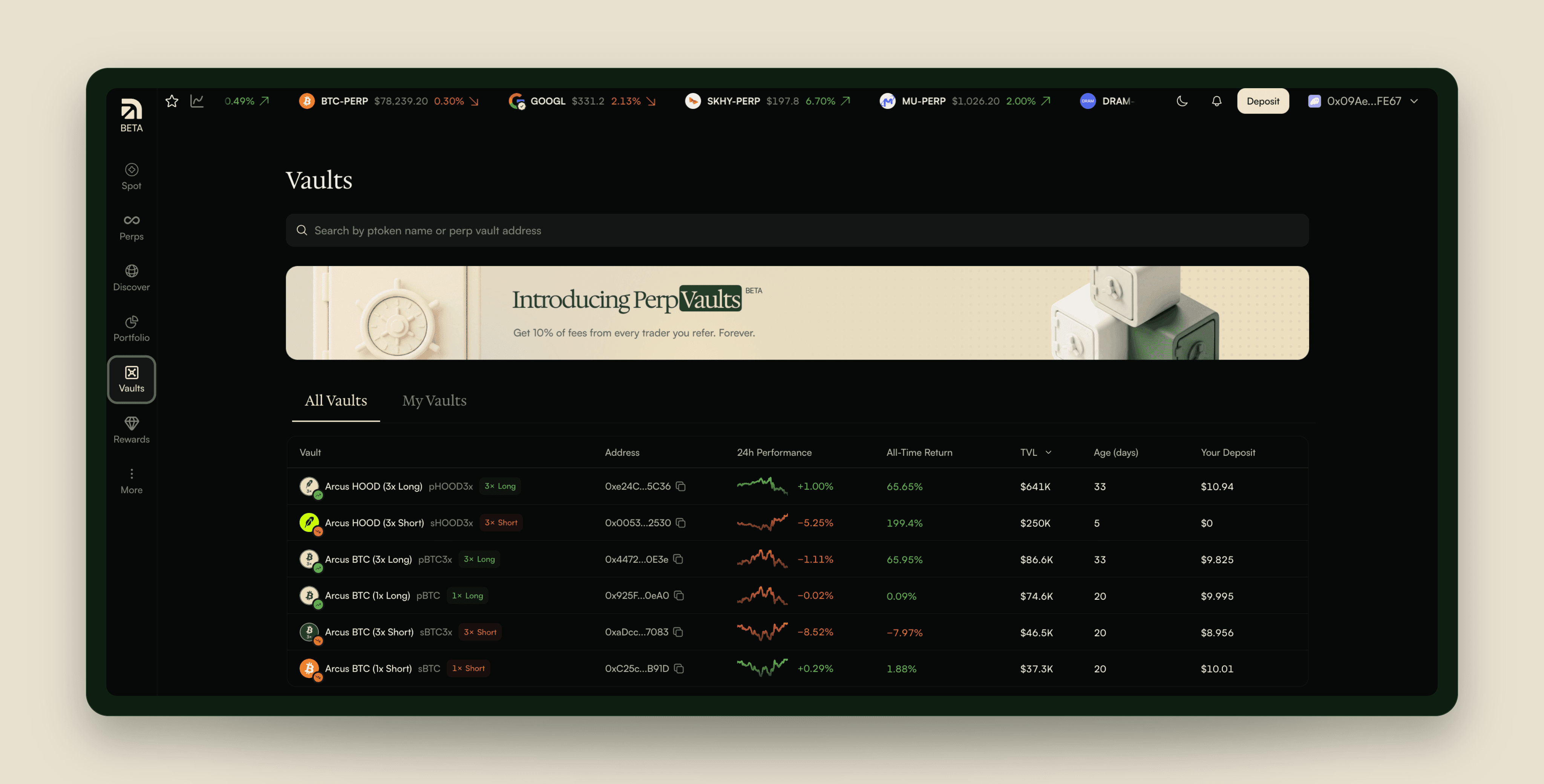
A pToken is defined by the strategy that its account runs. The first generation of pTokens keeps it simple: each pToken covers one market at one level of exposure, both fixed when it is created.
As an example, the pBTC pToken holds a long position in the BTC perps market targeting 1x leverage while the pBTC3x pToken targets 3x leverage. You can adopt different leverage strategies simply by buying and holding a pToken with the target exposure you’re looking for.
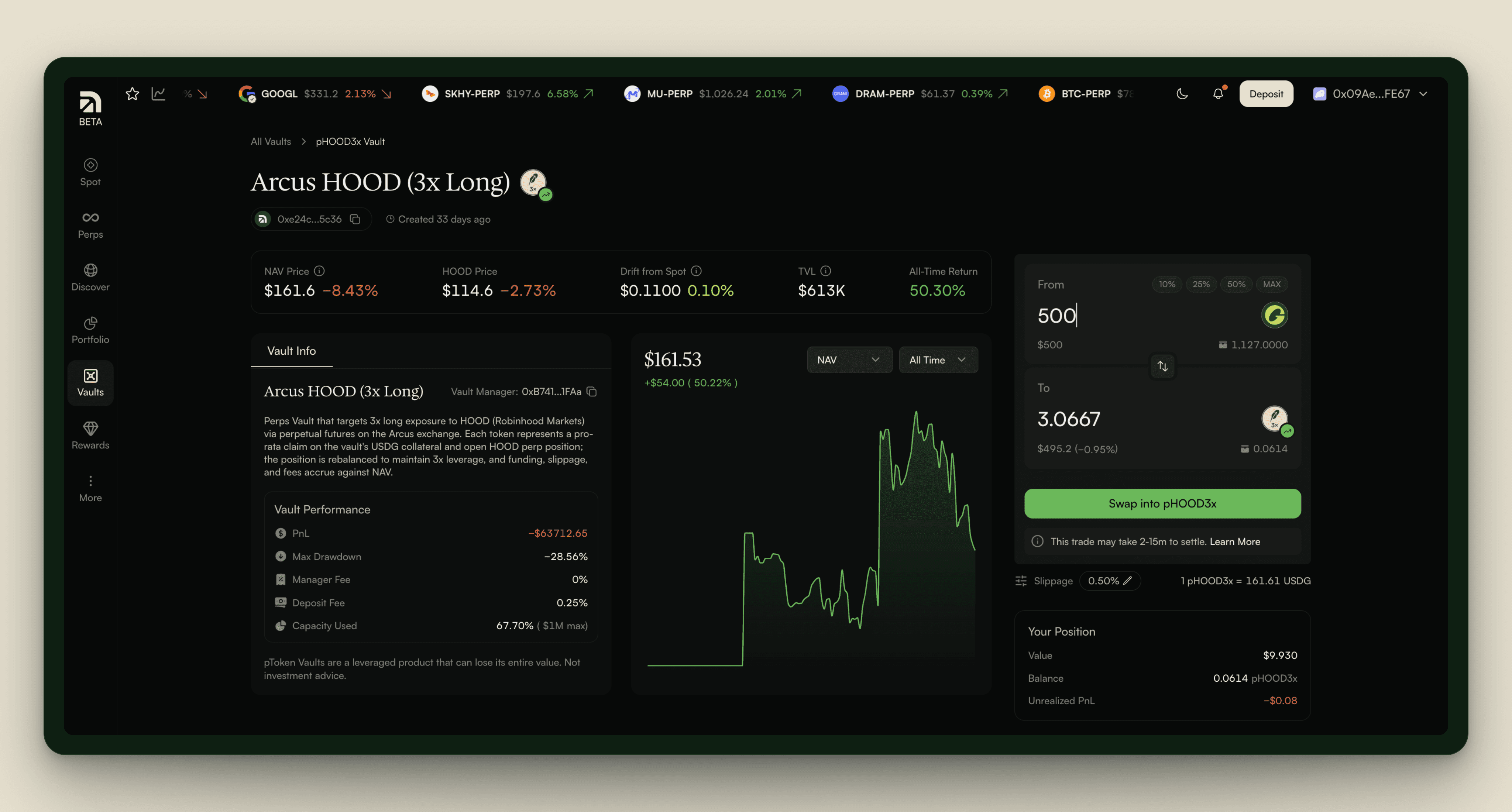
Everything else follows from it being a standard ERC-20. It sits in your wallet. It moves in one transfer. And it works with anything on Robinhood Chain built to handle ERC-20s.
What You’re Getting with pTokens
Holding a pToken gives you leveraged exposure, with none of the work that normally comes with it. No perps account to open, no collateral to post, no margin to watch, no position to manage. Each pToken is automatically rebalanced to keep it at its target exposure.
Buying and selling works like any other ERC-20 on Robinhood Chain, on Arcus, or on Uniswap. Want the exposure? Buy the token. Done with it? Sell it. That is the entirety of the interaction.
Keeping Exposure on Target
A fixed leverage position will not hold leverage on its own. The market moves, exposure drifts off target, and the account has to trade it back.
Traditional leveraged products do this on a schedule, typically once a day at the close, which leaves them exposed to everything the market does in between. By contrast, pTokens do not run on a fixed clock.
Rebalancing is triggered by the position itself: whenever drift passes a set threshold, the account trades back to target, whether that happens several times in a volatile hour or not at all on a quiet day. It rebalances exactly as often as the market requires, and no more, since every trade has a cost.
On a perpetuals market, margin is assessed continuously, and a leveraged position left unbalanced in a falling market becomes more leveraged as it falls. Threshold rebalancing works against that: each correction resets the position’s distance from liquidation, so a drawdown cannot compound uninterrupted between fixed rebalancing times.
Net Asset Value
Net Asset Value, or NAV, is what one pToken is worth. It constitutes the positions the account holds, plus any cash sitting alongside them, divided across every token in issue.
NAV is not the price of the underlying market. It is what holding the position actually earns and costs. It moves with the market, absorbs the hourly funding that perpetuals pay or collect, and carries the cost of the rebalancing trades that keep exposure on target.
NAV vs. Market Price
While NAV is what a pToken is worth. Market price is what people are paying for it. The two usually stay close, but they may diverge for two reasons: liquidity can be thin, and supply does not expand the moment demand does - it happens asynchronously.
Check both numbers before you trade. The distance between them is information.
Where the Price Comes From
A pToken is created when USDG is deposited into the respective perpetuals account. It is priced at the NAV recorded the moment the exchange processes that deposit, and that NAV is signed by an oracle and verified on-chain before any tokens exist. Nothing is minted at a stale number.
Large deposits are filled in parts rather than all at once. Pushed in as a single trade, the money would sit idle while the order worked through the market, and for that whole window everyone already holding the token would be less exposed than the position promises. Filling deposits in parts keeps the account close to fully invested. The delay is the protection.
For Builders
Functionally, a pToken wraps an externally managed set of assets and positions and lets them trade as fungible shares in the underlying holdings. The pToken contract adheres to the ERC-4626 vault interface, and specifically to the ERC-7540 asynchronous vault standard, since the mint and redeem flows are asynchronous.
That makes integration ordinary. Anything that holds, routes, or pools ERC-20s works with a pToken out of the box: collateral in a lending market, a pair in an AMM, or a listing on a launchpad.
Minting a pToken
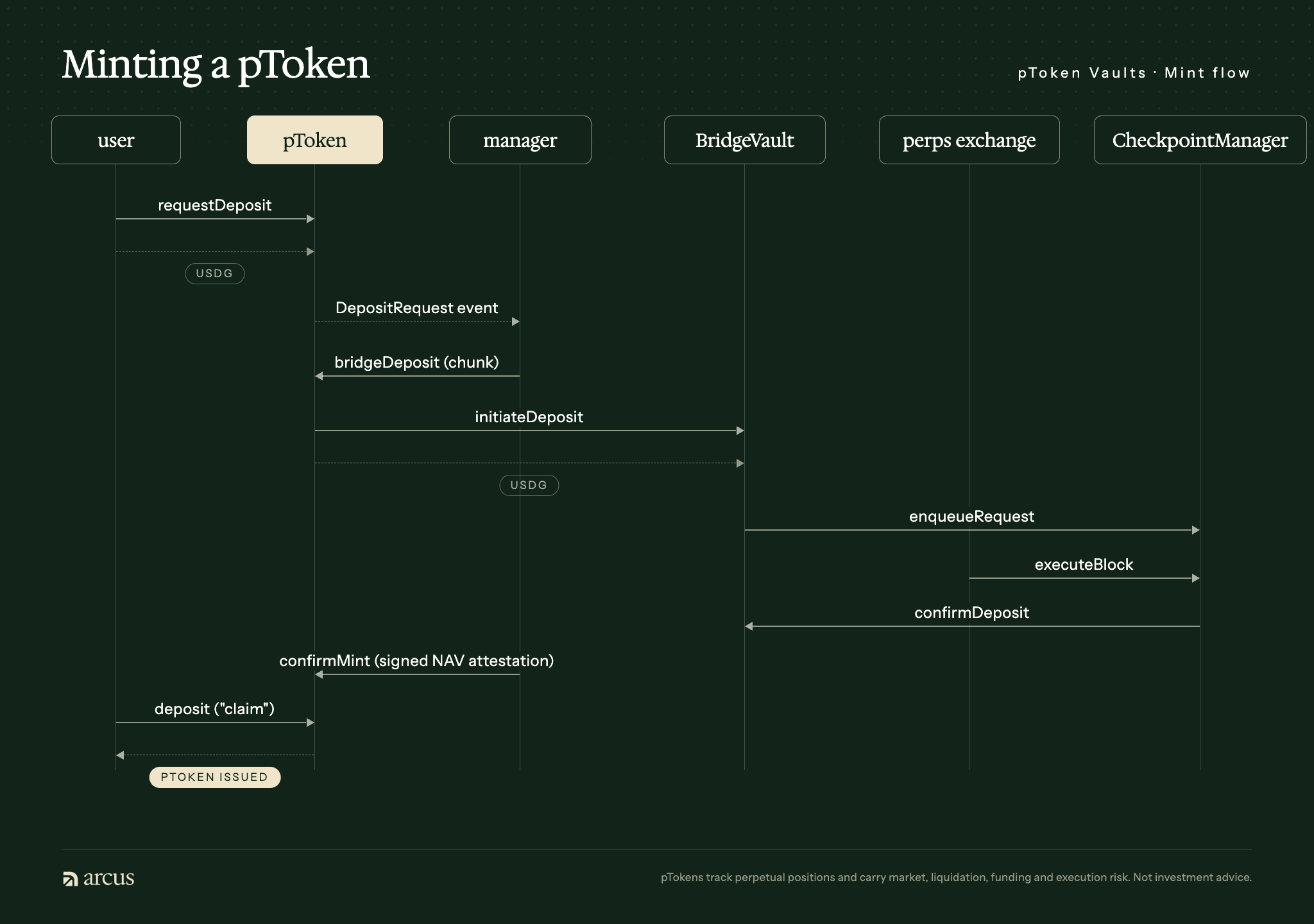
A mint request is submitted, and the USDG behind it is escrowed.
The request is accepted by the manager, and the USDG is deposited into the account on the exchange.
The deposit is processed by the exchange.
The NAV at the exact moment of processing is signed by the NAV oracle, an off-chain attester that publishes a signed value per request.
The signature is verified by the contract, and pTokens are minted at the signed value.
There are two ways tokens change hands. The primary market is minting and redeeming directly against the account. The secondary market is simply buying and selling the token on the open market such as Arcus or Uniswap, and it is open to everyone from day one. For holders, the secondary market is the route in and out.
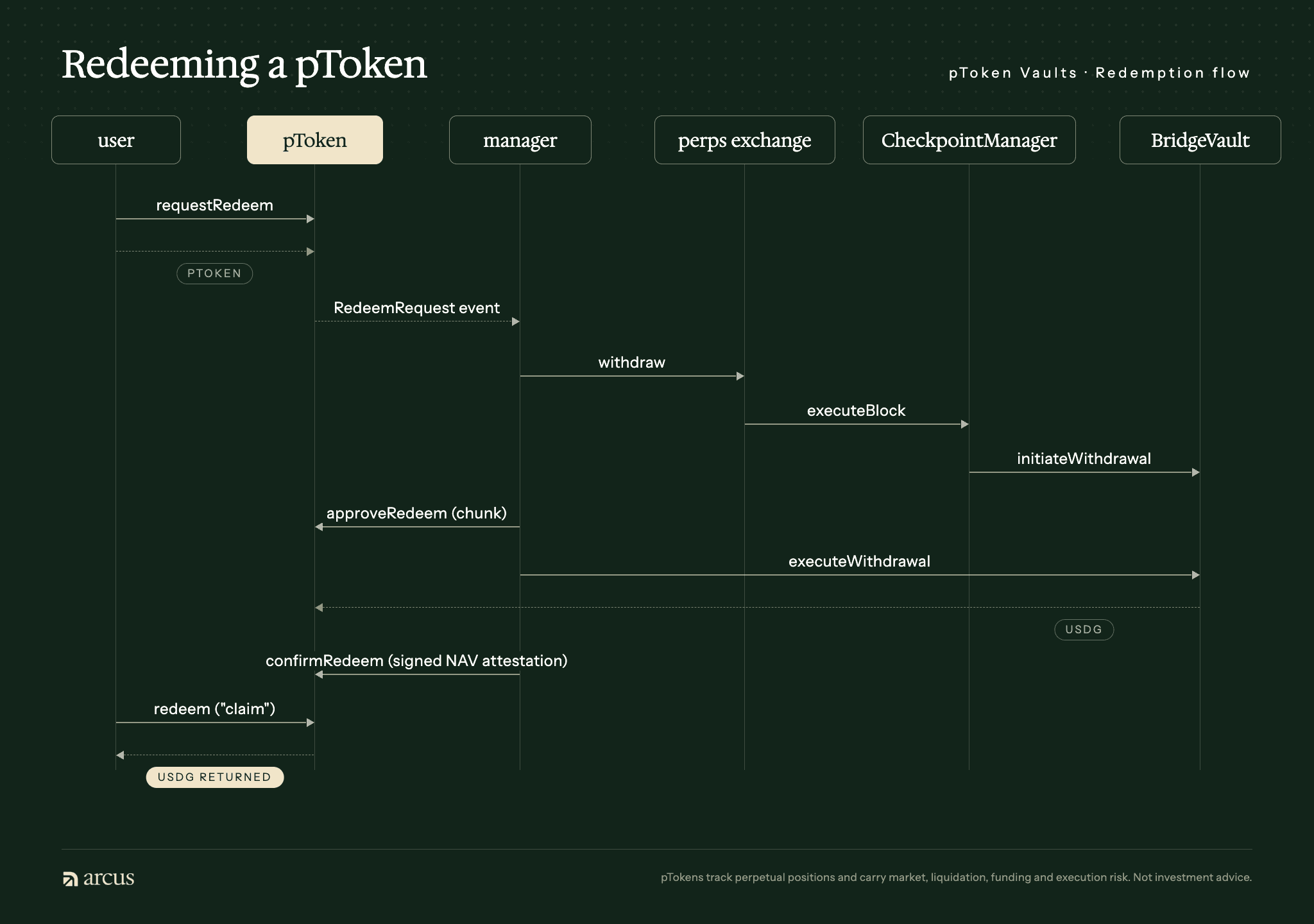
Redemptions follow the mint path in reverse:
Separating a position from the claim on it is among the oldest structures in markets, and it has outlasted almost everything built alongside it. With pTokens we’re bringing that idea to Arcus perpetuals, on a chain where a token can be held, moved, and built on freely.
A leveraged position has always been something you maintain. This is the version you hold.
Frequently asked questions
What is a pToken?
How do pTokens maintain their target leverage?
What is the difference between pToken NAV and market price?
How are pTokens minted and redeemed?
—-
Arcus is a blockchain-based smart contract protocol that permits self-custodial peer-to-peer trading of Stock Tokens, cryptoassets and perpetual futures. Arcus is not a regulated financial services provider, and it is not available in the U.S., Canada, United Kingdom and other restricted jurisdictions.
Stock Tokens are tokenised securities that provide economic exposure to a relevant underlying equity instrument or ETP through a contractual claim against the Issuer for a cash Redemption. Stock Tokens involve risks not present, or not present to the same extent, in traditional stock ownership, including private-key loss or compromise, limited redemption access, liquidity constraints, price or tracking divergences from the underlying, and uncertain or evolving regulatory treatment.
Trading Stock Tokens, crypto assets or perpetual futures is risky and involves risks of loss, particularly when using leverage. Do your own research.
This content is provided as a general tool for users to learn about or interact with Arcus on their initiative, with no endorsement or recommendation of any trading activities. Users or potential users of this content should not regard it as involving any form of recommendation, invitation or inducement to deal in Stock Tokens, cryptoassets or perpetual futures. Nothing herein should be used as legal, financial, tax, or any other form of advice.
In no event will Pocket Protector Labs Inc. or its affiliates be liable for any loss or damage arising from or in connection with the use of Arcus or this content. By continuing to access this content, you agree to the Interface Terms of Use, Protocol Terms and Privacy Policy.
Market analysis is facilitated with charts by independent third party service provider(s).