Página actual


Arcus
Todo operador de contratos perpetuos ha vivido alguna versión de esta noche: cinco posiciones abiertas, cuatro de ellas bien y una perdiendo. No le preocupa la operación que va perdiendo. Le preocupa el impacto que pueda tener en todo lo demás, ya que en el margen cruzado (cross margin), sus posiciones comparten el mismo destino. Un único fondo de garantía respalda todas ellas a la vez, y una mala noche en un mercado puede retirar el margen de cualquier otra operación que tenga abierta.
El margen cruzado es eficiente en términos de capital y es la opción predeterminada para la mayoría de los operadores en casi todo momento. Pero ese destino compartido es el precio a pagar, y todo operador se encuentra eventualmente con la noche en la que habría dado cualquier cosa para que una posición dejara de afectar al resto.
Las posiciones aisladas (isolated margin) son esa alternativa. Cada posición tiene asignado su propio margen, su propio precio de liquidación y sus propios límites. Lo que pasa dentro, se queda dentro.
Qué es una posición aislada
Una posición aislada es una posición de contratos perpetuos con una parte dedicada de garantía asignada exclusivamente a ella. Ese margen representa todo el derecho de la posición sobre su cuenta. Si el mercado se mueve en su contra, las pérdidas solo se detraerán del margen que se le asignó. Si se liquida, las pérdidas se detienen ahí. Todas las demás posiciones y el resto de su garantía permanecen intactos.
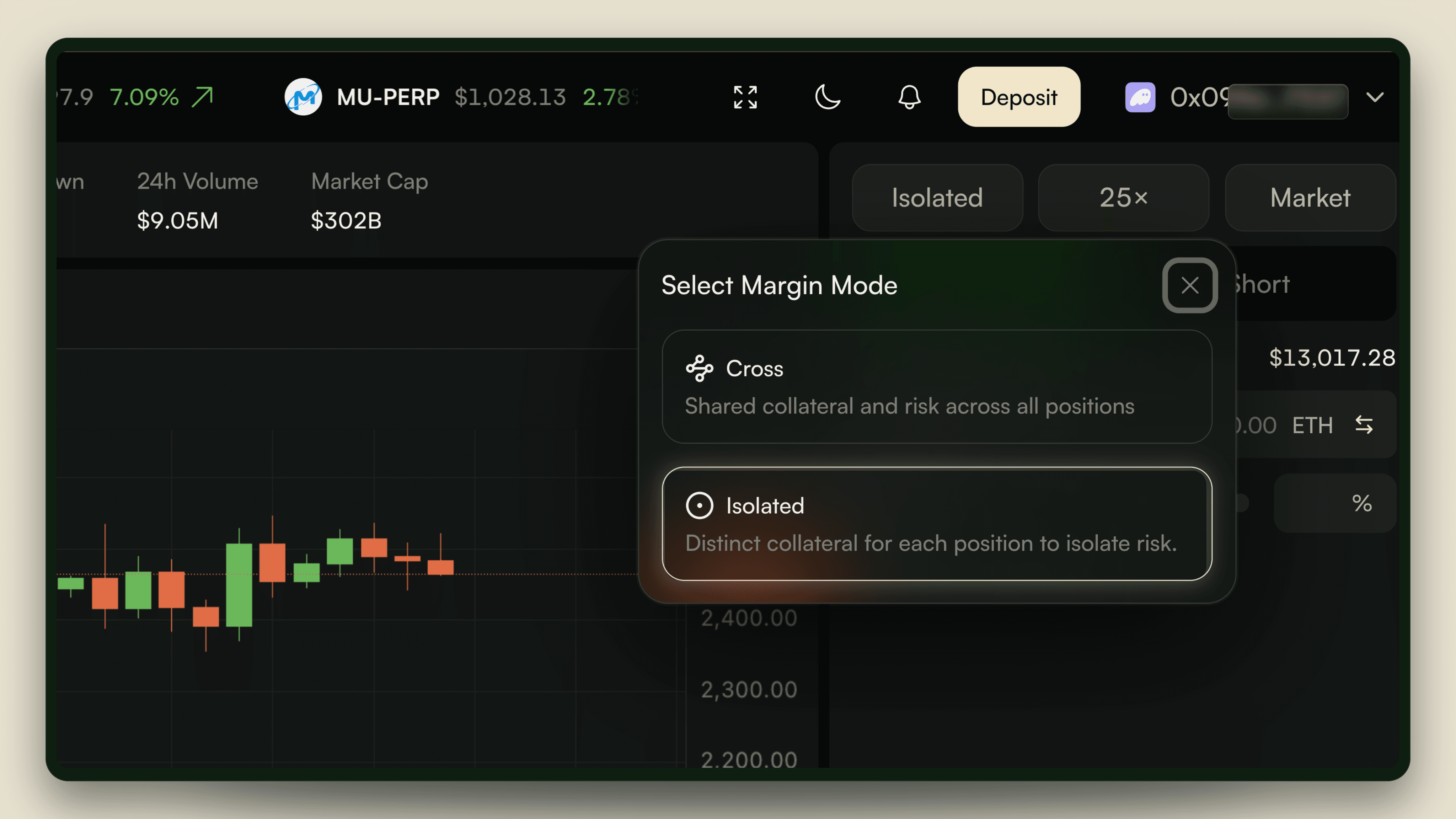
En la práctica: el margen que asigna es lo máximo que esa operación puede consumir. A menos que decida aportarle más. Puede añadir margen a una posición aislada o retirar el margen sobrante de una que esté funcionando bien, pero nada se mueve a menos que usted lo haga. El peor de los casos deja de ser una pregunta que responder a las 3 de la mañana y se convierte en una cifra que usted eligió y que solo puede modificar de forma voluntaria.
El margen cruzado no va a desaparecer. Ambos modos coexisten, elegidos posición por posición, y muchos operadores utilizan ambos: cruzado para el núcleo correlacionado e aislado para todo aquello que merezca su propio presupuesto.
Un ejemplo práctico
Supongamos que tiene $10.000 en garantía y cuatro posiciones abiertas. Quiere una quinta: una posición en largo de BTC en la que cree, pero que no desea tener que defender a las 3 de la mañana.
La abre de forma aislada y asigna $500 con un apalancamiento de 10x: una posición de $5.000. Su precio de liquidación aparece en el momento en que la abre, aproximadamente un 8,5% por debajo de su precio de entrada, calculado únicamente sobre esos $500.
BTC cae un 10% durante la noche. La posición se liquida y usted pierde los $500 que le asignó.
Sus otras cuatro posiciones nunca se movieron. Sus precios de liquidación nunca variaron. Los $9.500 restantes nunca estuvieron en riesgo.
La misma operación con margen cruzado: esa corrección del mercado se respaldaría con la totalidad de los $10.000, y el precio de liquidación de todas las demás posiciones se desplazaría a medida que la operación perdedora consumiera fondos.
Una sola cuenta, dos modos
Nada cambia en la cuenta. La misma propiedad de autocustodia, los mismos mercados. El aislamiento es una elección que se realiza por posición en el momento de la apertura, y el funcionamiento no varía. La financiación (funding), las comisiones y la liquidación funcionan igual en una posición aislada que en una de margen cruzado. La diferencia radica en el límite que puede alcanzar una pérdida.
Esa es la funcionalidad completa. Sin necesidad de depositar fondos en una cuenta nueva ni de aprender a usar otra interfaz. Solo una decisión más en la apertura, la decisión que define la operación: "¿cuánto se puede permitir perder esta idea?"
—-
Arcus es un protocolo de contratos inteligentes basado en blockchain que permite operar con tokens de acciones, criptoactivos y futuros perpetuos de igual a igual y con autocustodia. Arcus no es un proveedor de servicios financieros regulado y no está disponible en los EE. UU., Canadá, el Reino Unido y otras jurisdicciones restringidas.
Los tokens de acciones son valores tokenizados que proporcionan exposición económica a un instrumento de renta variable subyacente o ETP relevante mediante un derecho contractual frente al emisor para un reembolso en efectivo. Los tokens de acciones implican riesgos que no están presentes, o no en la misma medida, en la propiedad de acciones tradicional, incluidos la pérdida o compromiso de claves privadas, el acceso limitado al reembolso, las limitaciones de liquidez, las divergencias de precios o de seguimiento respecto al activo subyacente y un tratamiento regulatorio incierto o en evolución.
Operar con tokens de acciones, criptoactivos o futuros perpetuos es arriesgado e implica riesgo de pérdida, especialmente cuando se utiliza apalancamiento. Realice su propia investigación.
Este contenido se proporciona como herramienta general para que los usuarios conozcan o interactúen con Arcus por iniciativa propia, sin respaldo ni recomendación de ninguna actividad comercial. Los usuarios o posibles usuarios de este contenido no deben considerarlo como ningún tipo de recomendación, invitación o inducción para operar con tokens de acciones, criptoactivos o futuros perpetuos. Nada de lo aquí expuesto debe utilizarse como asesoramiento legal, financiero, fiscal o de cualquier otra índole.
En ningún caso Pocket Protector Labs Inc. o sus filiales serán responsables de cualquier pérdida o daño derivado de o en relación con el uso de Arcus o de este contenido. Al continuar accediendo a este contenido, acepta las Condiciones de uso de la interfaz, las Condiciones del protocolo y la Política de privacidad.
El análisis de mercado se facilita mediante gráficos provistos por proveedores de servicios externos independientes.
