Page actuelle


Arcus
Tout trader de contrats perpétuels (perps) a déjà vécu une nuit comme celle-ci : cinq positions ouvertes, quatre se portent bien, et une est en perte. Vous ne vous inquiétez pas de la transaction qui perd. Vous vous inquiétez de l'impact qu'elle a sur tout le reste, car en marge croisée (cross margin), vos positions partagent un destin commun. Un seul panier de garanties (collateral) soutient toutes vos positions à la fois, et une mauvaise nuit sur un seul marché peut vider la marge de toutes vos autres transactions en cours.
La marge croisée est efficace en capital et constitue le choix par défaut de la plupart des traders, la majorité du temps. Mais ce destin partagé en est le prix, et chaque trader finit par connaître cette nuit où il aurait payé n'importe quoi pour qu'une position cesse d'avoir un impact sur le reste.
Les positions isolées constituent cette alternative. Chaque position dispose de sa propre marge, de son propre prix de liquidation et de ses propres barrières. Ce qui se passe à l'intérieur y reste.
Qu'est-ce qu'une position isolée ?
Une position isolée est une position perpétuelle dotée d'une tranche de garantie dédiée, qui lui est exclusivement attribuée. Cette marge constitue la seule créance de cette position sur votre compte. Si le marché se retourne contre elle, les pertes ne portent que sur la marge qui lui a été allouée. En cas de liquidation, les pertes s'arrêtent là. Toutes vos autres positions et le reste de votre garantie restent intacts.
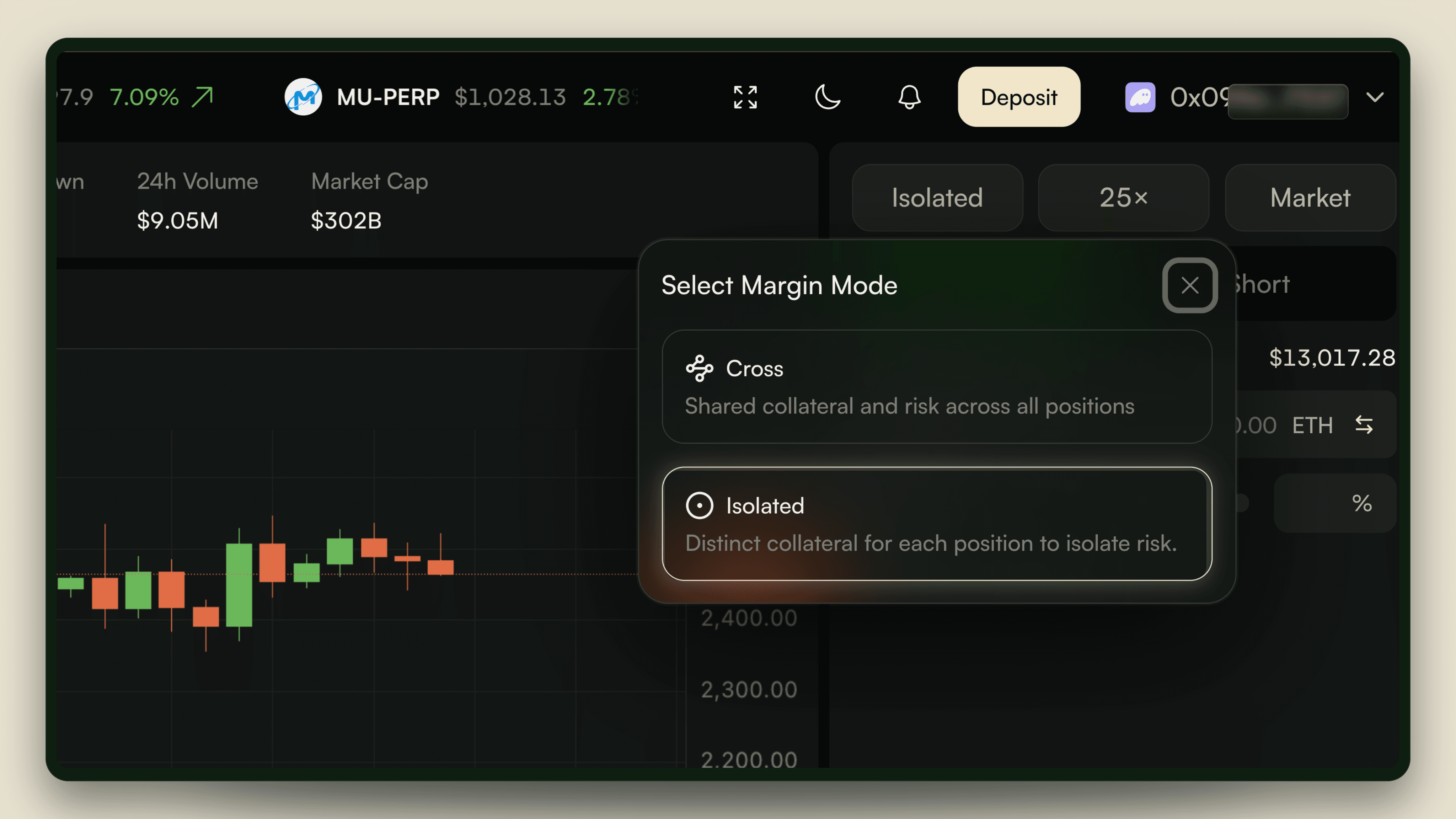
En pratique : la marge que vous attribuez est le maximum que cette transaction peut absorber. Sauf si vous décidez de lui en accorder davantage. Vous pouvez ajouter de la marge à une position isolée, ou en retirer d'une position gagnante, mais rien ne bouge sans votre intervention. Le pire des scénarios n'est plus une question à laquelle vous devez répondre à 3 heures du matin, mais devient un chiffre que vous avez choisi et que vous ne pouvez modifier que délibérément.
La marge croisée ne va pas disparaître pour autant. Les deux modes coexistent, choisis position par position, et de nombreux traders utilisent les deux : la marge croisée pour le cœur de portefeuille corrélé, et la marge isolée pour tout ce qui mérite son propre budget.
Un exemple concret
Supposons que vous disposiez de 10 000 $ de garantie et de quatre positions en cours. Vous souhaitez en ouvrir une cinquième : une position longue sur le BTC en laquelle vous croyez, mais que vous ne voulez pas avoir à défendre à 3 heures du matin.
Vous l'ouvrez en mode isolé et y attribuez 500 $ avec un effet de levier de 10x, soit une position de 5 000 $. Votre prix de liquidation apparaît dès l'ouverture, environ 8,5 % en dessous de votre cours d'entrée, calculé uniquement sur la base de ces 500 $.
Le BTC chute de 10 % pendant la nuit. La position est liquidée et vous perdez les 500 $ que vous lui aviez attribués.
Vos quatre autres positions n'ont pas bougé. Leurs prix de liquidation n'ont pas changé. Les 9 500 $ restants n'ont jamais été menacés.
La même transaction en marge croisée : cette baisse aurait puisé dans l'intégralité des 10 000 $, et le prix de liquidation de toutes les autres positions aurait fluctué à mesure que celle-ci perdait de la valeur.
Un seul compte, deux modes
Rien ne change concernant votre compte. Même propriété non dépositaire (self-custodial), mêmes marchés. L'isolation est un choix effectué par position à l'ouverture, et le fonctionnement reste identique. Le financement (funding), les frais et la liquidation fonctionnent de la même manière dans une position isolée qu'en marge croisée. La seule différence réside dans la limite de la perte possible.
Voilà toute la fonctionnalité. Pas de nouveau compte à approvisionner, pas de nouvelle interface à apprendre. Une seule décision supplémentaire à l'ouverture, et c'est celle qui définit la transaction : « combien cette idée est-elle autorisée à me coûter ? »
—-
Arcus est un protocole de contrats intelligents basé sur la blockchain permettant le trading de pair à pair non dépositaire de Jetons d'Actions (Stock Tokens), de crypto-actifs et de contrats à terme perpétuels. Arcus n'est pas un fournisseur de services financiers réglementé et n'est pas disponible aux États-Unis, au Canada, au Royaume-Uni ainsi que dans d'autres juridictions restreintes.
Les Jetons d'Actions sont des titres tokenisés qui offrent une exposition économique à une action sous-jacente ou à un ETP par le biais d'un droit contractuel contre l'Émetteur pour un remboursement en espèces (Redemption). Les Jetons d'Actions comportent des risques absents, ou présents à un degré moindre, dans la détention d'actions traditionnelle, notamment la perte ou le compromis de clés privées, un accès limité au remboursement, des contraintes de liquidité, des écarts de prix ou de suivi par rapport au sous-jacent, ainsi qu'un traitement réglementaire incertain ou en évolution.
Le trading de Jetons d'Actions, de crypto-actifs ou de contrats à terme perpétuels est risqué et comporte des risques de perte, en particulier lors de l'utilisation de l'effet de levier. Faites vos propres recherches.
Ce contenu est fourni en tant qu'outil général permettant aux utilisateurs de s'informer sur Arcus ou d'interagir avec le protocole de leur propre initiative, sans approbation ni recommandation d'activités de trading. Les utilisateurs ou utilisateurs potentiels de ce contenu ne doivent pas le considérer comme une forme de recommandation, d'invitation ou d'incitation à négocier des Jetons d'Actions, des crypto-actifs ou des contrats à terme perpétuels. Rien dans le présent document ne doit être utilisé comme un conseil juridique, financier, fiscal ou de toute autre nature.
En aucun cas Pocket Protector Labs Inc. ou ses affiliés ne seront tenus responsables de toute perte ou dommage découlant de ou lié à l'utilisation d'Arcus ou de ce contenu. En continuant à accéder à ce contenu, vous acceptez les Conditions d'utilisation de l'interface, les Conditions du protocole et la Politique de confidentialité.
L'analyse de marché est facilitée par des graphiques fournis par un ou plusieurs prestataires de services tiers indépendants.
